
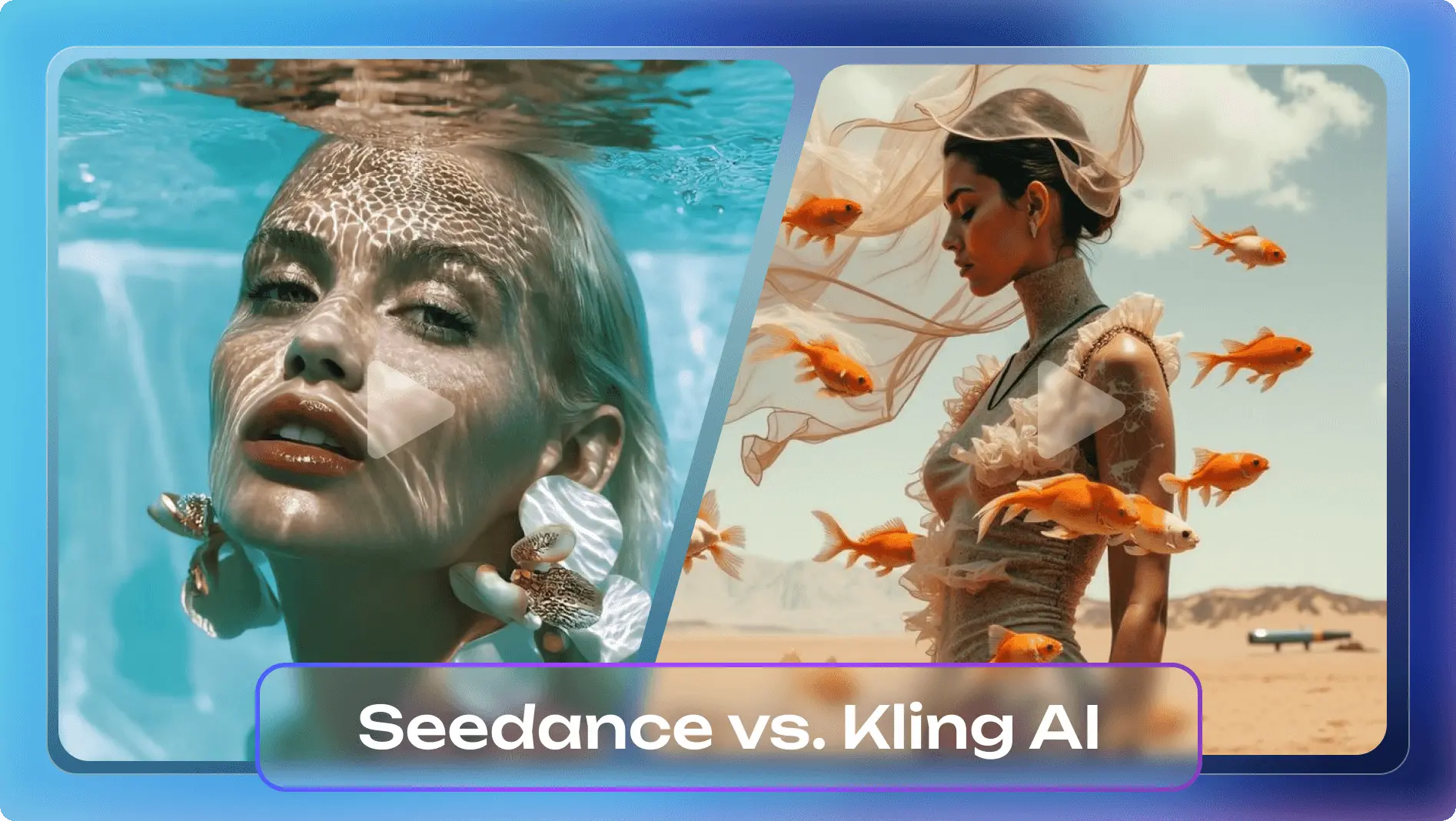
If you’ve been exploring AI video tools lately, you’ve probably come across two names more than once: Seedance and Kling AI. And the question that keeps coming up is always the same— which one feels more real? Because motion realism isn’t just a detail, it’s the heartbeat. It decides whether a video draws you in or just gets passed by.
When we talk about realism in AI motion, we’re talking about flow. Movements that shift naturally without breaking. Physics that behave the way we expect them to—hair lifting and falling, clothes moving with the body. Faces that don’t glitch when they emote. Spaces that respond to action instead of ignoring it. And above all, the quiet consistency between frames that makes you forget you’re watching AI at all.
Seedance leans into stylized realism. It knows how to look cinematic, how to hold stillness, how to make slow or expressive gestures feel composed and intentional. That cinematic, composed motion shines in the real-world Seedance 2.0 use cases for video and animation, including turning live action into cartoon and anime.
Its strength is in storytelling shots where pace is slower, moods heavier, visuals steadier. It doesn’t usually collapse into big distortions, and the frame feels dependable. But when you push it into speed—dancing, running, fighting—it starts to slip. Movements can turn stiff, almost too smooth, and the smaller details like hands or quick turns don’t always keep up. It’s beautiful, yes, but sometimes beautiful in a rehearsed way.

Kling, on the other hand, leans hard into realism. Everyday movements—walking, talking, small gestures-land more naturally. Its real advantage is in physics: clothes ripple, hair reacts, shadows fall where they should. When the pace picks up, Kling usually holds its ground better than Seedance, letting motion carry through in a way that feels alive. It isn’t flawless but faces can warp during extreme action, hands still trip it up—but it pushes further into the territory of lifelike motion. The trade-off is that it demands more: more power, more time, more patience.
Side by side, the difference is clear. Seedance gives you cinematic control, something steady and styled. Kling gives you realism, a movement that feels less staged. Seedance shines when you want artful shots that live in mood. Kling shines when you need dynamic energy that convinces the eye.
So which should you use? It depends on your project. For stylized edits, short films, or mood-heavy visuals, Seedance has a natural edge. For realism—commercials, sports edits, professional projects—Kling is ahead right now. But the real answer might be both. Many creators already use Seedance for the storytelling shots and Kling for the high-motion ones. Together, they balance style with truth.
Right now, Kling edges forward in realism. But Seedance holds its ground in consistency and cinematic mood. AI video is changing fast, and both are getting sharper with every update. Instead of searching for the winner, the smarter approach might be learning how to use both—picking the one that fits the moment.
You can widen that lineup with the Google Veo 3 model, which adds native audio and advanced physics to the mix.
You can widen that toolkit even further with the Luma Ray 2 video model, which delivers fast, physics-accurate motion for single-shot scenes.
That’s where you’ll find the best results: motion that doesn’t just move but feels alive.
You can widen your toolkit even further by adding the PixVerse video model to the mix for stylized, motion-rich clips. You can also add the Veo 3 Fast video model to that rotation whenever you need speed and synced audio over maximum detail.
What Happens After Motion? The Factors That Decide Whether an AI Video Looks Professional
Your original comparison focuses on motion realism, cinematic quality, and physics. Those are the biggest talking points, but they are far from the only ones creators care about. Once someone has decided that both models produce impressive movement, the next questions become much more practical.
Many creators ask ChatGPT things like:
"Why does my AI video still look fake even though the motion is good?"
"Which AI video model follows prompts more accurately?"
"Does camera movement matter more than character animation?"
"Why do AI videos lose quality halfway through?"
These questions point toward something much bigger than motion alone. Professional looking AI video comes from several systems working together, not one single capability.
Motion Is Only One Piece of Realism
A convincing AI video depends on multiple elements working in harmony.
Imagine a person walking through a rainy street.
The walking animation might be perfectly natural, but viewers immediately notice problems if:
- reflections disappear between frames
- raindrops stop reacting to movement
- clothing changes shape every second
- lighting changes without reason
- camera movement jitters unexpectedly
Even excellent motion cannot hide these problems.
Professional creators usually evaluate AI videos using several quality categories rather than asking only one question. Native audio is one such category, and Google Veo 3 Flow stands out by generating synchronized dialogue and music alongside the motion.
These include:
- Motion continuity
- Prompt accuracy
- Camera behavior
- Character consistency
- Environmental consistency
- Object permanence
- Lighting stability
- Render cleanliness
The strongest AI models perform well across every category rather than dominating only one.
"Which AI video model follows prompts more accurately?"
Prompt adherence has quietly become one of the biggest differences between modern AI video generators.
Motion quality receives most of the attention on social media, but commercial creators often care far more about whether the model follows instructions correctly.
For example, consider this prompt.
"A woman wearing a red trench coat walks through Tokyo during heavy rain while holding a transparent umbrella. The camera slowly circles around her before ending with a close up."
A strong model should preserve:
- red trench coat
- transparent umbrella
- rainy environment
- Tokyo inspired streets
- circular camera movement
- close up ending
- same character throughout
If one of these changes during generation, prompt accuracy begins to drop.
Seedance generally performs well when prompts emphasize atmosphere, mood, lighting and artistic composition.
Examples include:
- dreamy lighting
- emotional storytelling
- cinematic framing
- slow dramatic pacing
- fashion editorials
- luxury advertising
Kling tends to perform better when prompts involve physical actions. If your scenes revolve around movement and physical realism, the Kling AI model is built to render that kind of believable motion.
Examples include:
- running
- jumping
- dancing
- sports
- crowds
- vehicle movement
- animals
- complex interaction between people
This explains why many commercial creators choose different models depending on the project instead of relying on one generator for every scene.
Why do AI videos become inconsistent halfway through?
One of the biggest weaknesses across every current AI video model is long sequence consistency.
The longer the video becomes, the more opportunities the model has to introduce small errors. That's exactly the weakness Google is expected to tackle next, as detailed in our look at Veo 4's rumored longer, more consistent video.
These often begin as tiny details.
Hair length changes.
Buttons disappear.
Jewelry moves.
Background people change clothes.
Lighting becomes warmer.
Facial expressions slowly drift.
These problems accumulate until viewers begin noticing something feels off.
Professional editors solve this problem by breaking larger scenes into multiple shorter generations.
For example, rather than generating one 30 second clip, they might produce:
- six separate five second shots
- individual camera angles
- matching lighting prompts
- identical character references
- identical seed values when available
The final video looks more polished because every segment remains easier for the AI model to maintain consistently.
This workflow has become common across commercial AI production teams because shorter generations usually produce cleaner results.
Camera Movement Is Becoming More Important Than Character Movement
Another trend receiving much less attention is camera realism.
Early AI video models concentrated almost entirely on moving characters.
Modern creators increasingly judge videos based on how naturally the virtual camera behaves.
Professional cinematography includes movement such as:
- slow dolly shots
- crane movements
- handheld motion
- smooth tracking
- orbital camera paths
- gradual zooms
- controlled focus changes
Poor camera movement immediately reveals an AI generated clip, even if the character animation looks convincing.
For social media this may not matter very much.
For advertisements, product launches, documentaries and cinematic storytelling, camera quality often separates amateur results from professional work.
This is one reason experienced creators spend considerable time refining camera instructions inside prompts rather than only describing the subject.