

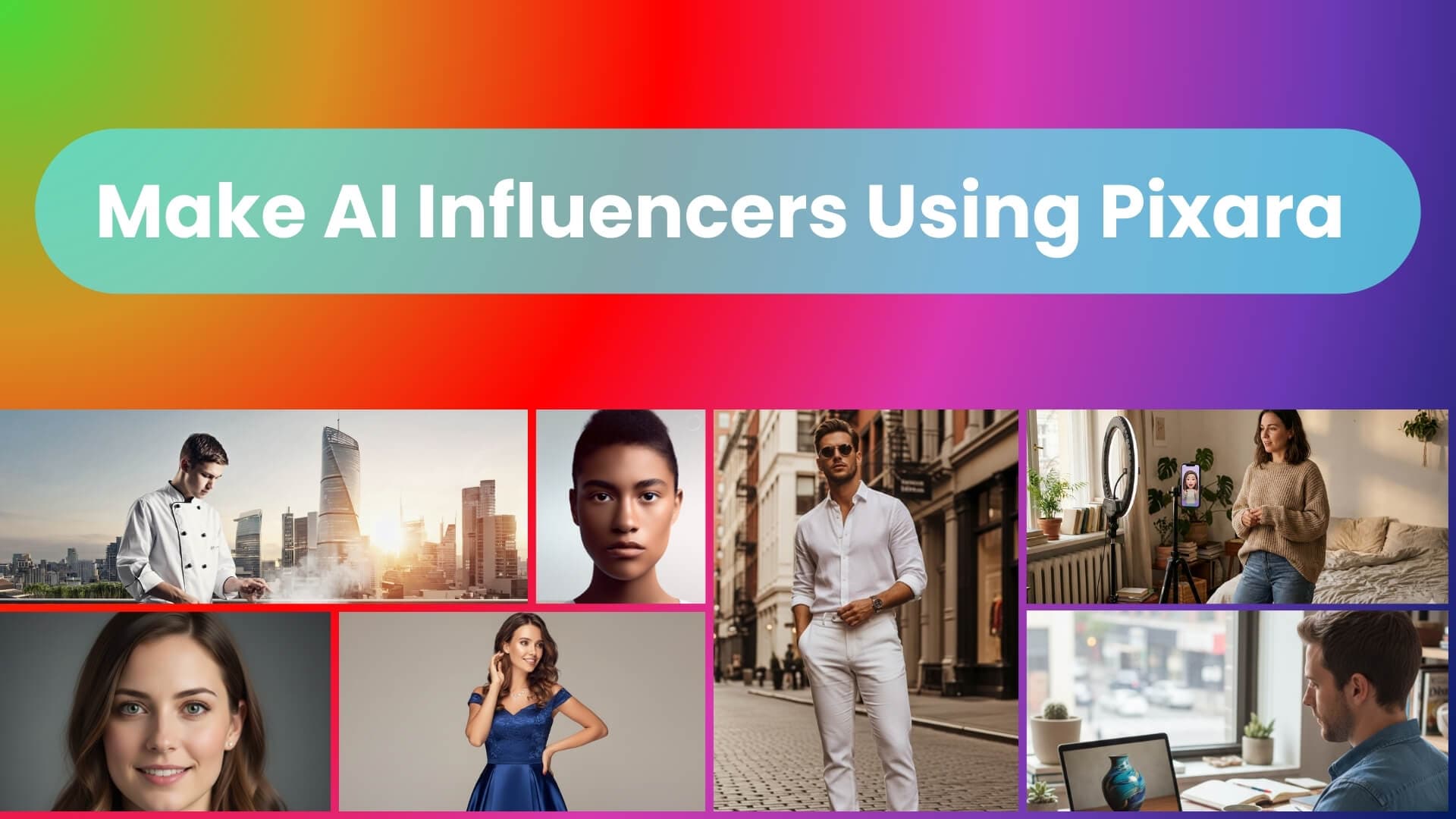
The creator economy is currently valued at over $250 billion. But the fastest-growing stars in this universe never sleep, never age, and never take a sick day. They are AI influencers, digital personas like Lil Miquela or Aitana Lopez who command millions of followers and secure six-figure brand deals.
A year ago, creating a consistent, hyper-realistic AI influencer required a degree in computer science and an expensive dedicated GPU. Today, the barrier to entry has collapsed, because if you have a laptop and a vision, you can build the next big digital brand.
At Pixara, we’ve consolidated all the tools necessary to build these digital empires into one dashboard.
You can also drive that dashboard programmatically with the Pixara MCP server, connecting it to Claude, ChatGPT, and other AI agents.
Here is your step-by-step blueprint for creating an AI influencer using Pixara AI.
Step 1:
Before you generate a single pixel, you need a plan. A successful AI influencer is a character with a story, a personality, and a niche. This is what makes them relatable and followable. This can be done by giving the influencer a name, age, backstory, a style, and a niche.
According to this Aurora article on the business of AI influencers, a well-defined persona is the key to building authentic connections with a human audience.
Below is a conceptualization of this step within the Pixara interface.

Step 2:
Now that you have a persona, it's time to bring them to life. Pixara's suite of AI tools makes this process seamless.
A. Generate the Base Image
Your influencer's look is their brand. Start by using Pixara's powerful Image Generator to create a high-quality, photorealistic portrait of your character. Be specific in your prompt to get the exact look you want.
For example, a prompt like: A portrait of a young woman with pink hair, wearing a streetwear hoodie, in a sunlit cafe.
This initial image will serve as the reference for all future content.

B. Achieve Consistency with Image-to-Image
The biggest challenge with AI influencers is maintaining a consistent face across different photos. Maintaining that consistency across hundreds of assets is a production challenge, which is why it helps to know the best creative studios for scalable ad production. This is where Pixara's Image-to-Image tool shines.
You can upload your base image and use a new prompt to place your influencer in a different setting, change their outfit, or alter the time of day, all while keeping their facial features identical. Automating repetitive steps like these is exactly what our guide to AI workflow automation for design teams is about. This is a game-changer for creating a believable Instagram feed.
As highlighted by TechCrunch, character consistency is the next frontier for generative art, and Pixara's tools are at the forefront of solving this problem.

C. Give Them a Voice and Bring Them to Life
To truly compete on platforms like TikTok and Instagram Reels, your influencer needs to move and speak. To make your persona move convincingly, explore the real-world applications of Seedance 2.0 for video and animation and its physics-driven motion. Pixara's all-in-one suite includes:
- Text-to-Speech AI Voiceovers in which you generate a unique, natural-sounding voice for your influencer. You can choose from a variety of accents, tones, and languages to match their persona.
- Image-to-Video which all you to take your static images and turn them into short, engaging video clips. The Google Veo 3 model takes this further, animating your character's images with lifelike motion and matching audio. Make your influencer blink, smile, or move their head to add a layer of realism that static images can't achieve.
The PixVerse image-to-video model is ideal for this, turning your character's still images into short, engaging clips with lifelike motion. Similarly, the Luma Ray 2 image-to-video model handles this beautifully, animating your character's stills with lifelike, natural motion.

Step 3: Build Your Empire on Social Media
With your influencer created, it's time to introduce them to the world.
- Choose Your Platform: Instagram is ideal for high-quality photos and fashion content, while TikTok is perfect for short-form videos and trends.
- Develop a Content Strategy: Plan out your posts. Mix lifestyle shots with interactive content like Q&As. Use your influencer's persona to comment on current events or trends.
- Engage with Your Audience: The key to growth is interaction. Reply to comments, participate in challenges, and collaborate with other creators (both human and AI).
The market for AI is projected to reach $1.3 trillion by 2032, according to Bloomberg Intelligence, and AI influencers are poised to capture a significant portion of this value.
Ready to create your own AI influencer? Sign up for Pixara.ai and get started for free.